
ultraQUTE: ultrafast QUantum THz nanoElectronicsultraQUTE
Research

Recent Results

Highlights from our latest papers and preprints.

Figure from the paperDevice architecture with integrated THz optoelectronics, pump and probe laser beams, and the chip layout
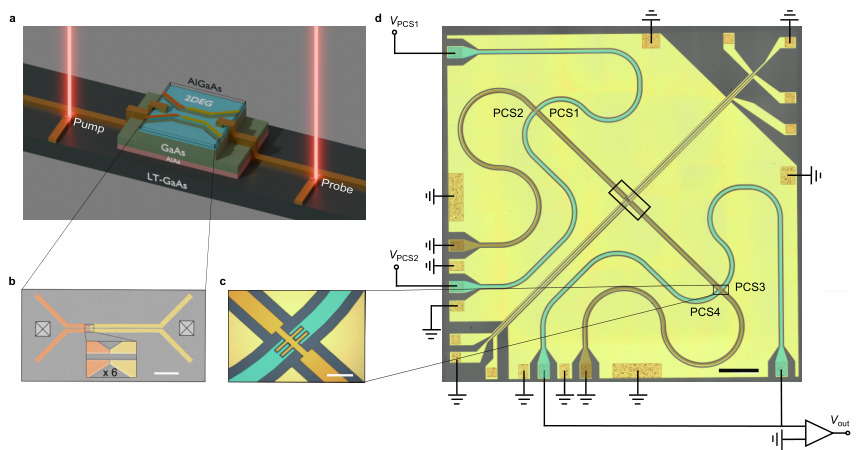
Fig. 1 of arXiv:2609.28224, CC BY 4.0

Active control of THz plasmon propagation in a one-dimensional electronic waveguide

arXiv:2609.28224 · 2026

We inject electron wavepackets as short as 4 ps into a quasi-one-dimensional electron waveguide, 10 to 40 µm long, and actively control their propagation speed. This is a building block for ultrafast quantum operations with flying electrons.
Read the paper

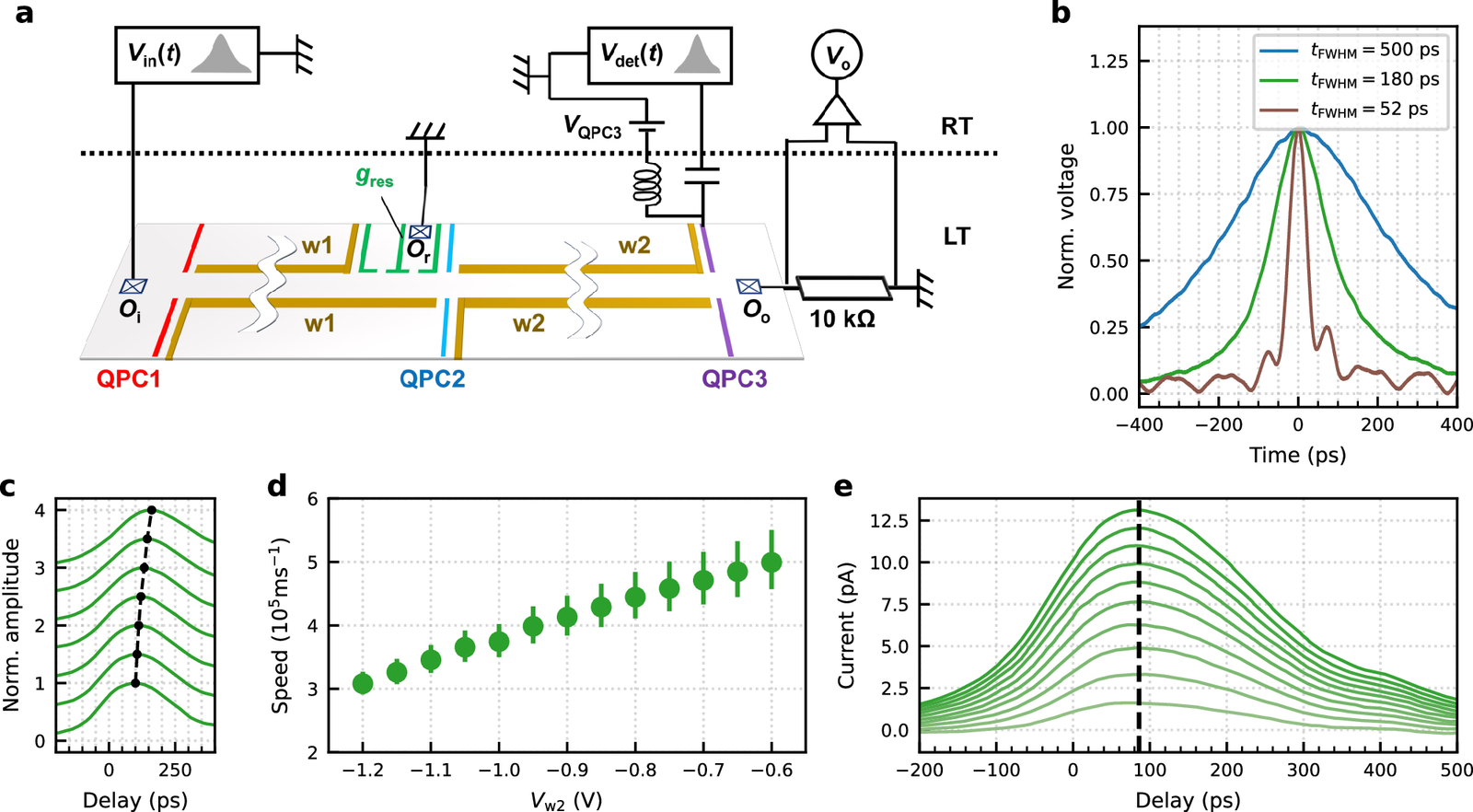
Figure from the paperSchematic of the electron waveguide device and time-resolved measurements of plasmon wavepackets
Fig. 1 of Takada et al., Nat. Commun. 16, 9942 (2025), CC BY 4.0

Eigenstate control of plasmon wavepackets with electron-channel blockade

Nature Communications 16, 9942 · 2025

Using a cavity, we isolate and select the electron conduction channels that contribute to a plasmon wavepacket, which gives precise control of its eigenstate and so of its propagation speed.

Read the paper

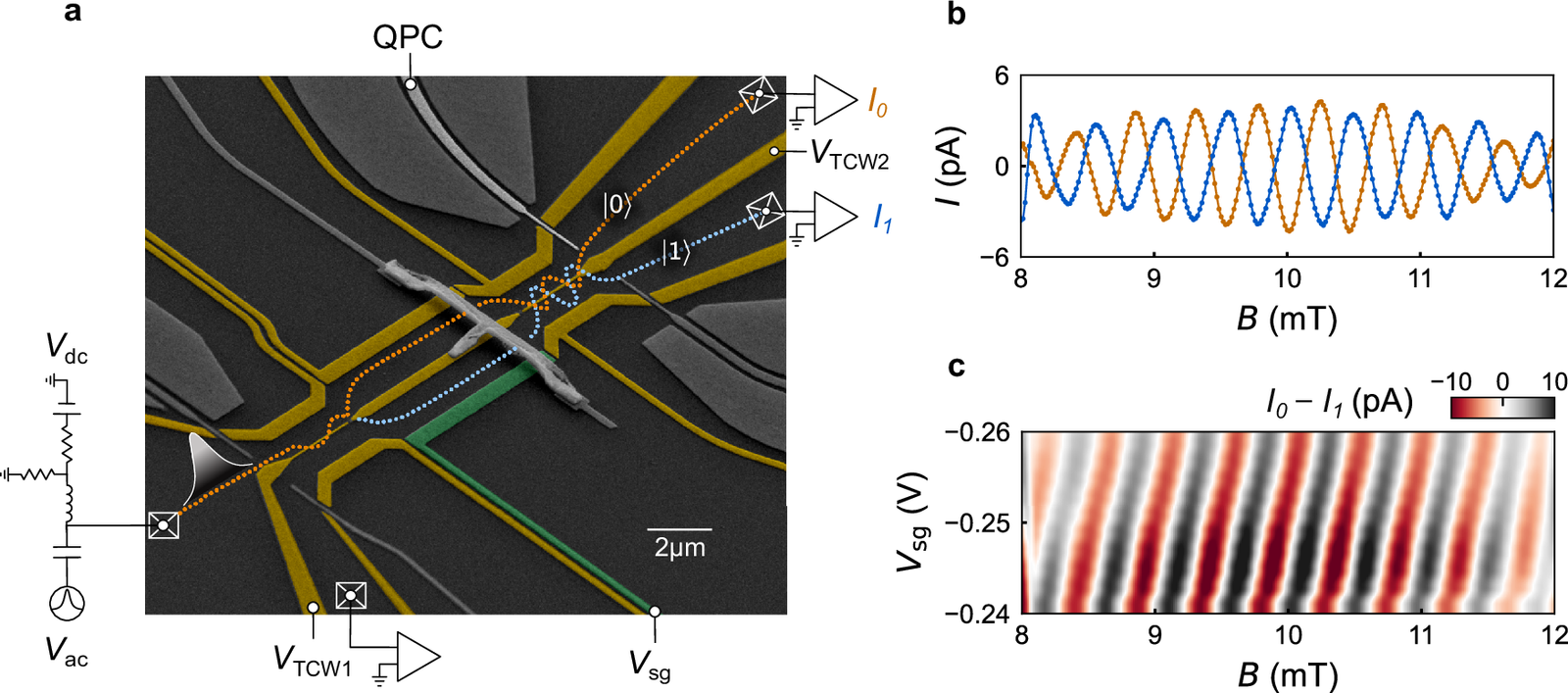
Figure from the paperScanning electron micrograph of the electronic Mach-Zehnder interferometer with Aharonov-Bohm oscillations of the current
Fig. 1 of Ouacel et al., Nat. Commun. 16, 4632 (2025), CC BY-NC-ND 4.0

Electronic interferometry with ultrashort plasmonic pulses

Nature Communications 16, 4632 · 2025

We inject ultrashort single-electron plasmonic pulses into a 14-micrometre-long electronic Mach-Zehnder interferometer, a step towards flying electron qubits operated on picosecond time scales.

Read the paper

THz electronics enabled by cost-effective germanium semiconductors

IRMMW-THz 2025 · 2025

Germanium as a low-cost semiconductor platform for THz electronics.

Read the paper